

DNS in NetBird
Updated
NetBird provides centralized DNS management to help your peers resolve domain names within your private network and control how they access external domains.
Key Concepts
- Nameserver: A DNS server that NetBird distributes to peers. You configure these in the dashboard under DNS → Nameservers.
- Match Domains: Specific domains that should be resolved by a particular nameserver (e.g.,
company.internal). Adding a domain automatically matches all its subdomains. - Primary Nameserver: The default nameserver that handles all domains not matched by specific rules. Configured by leaving match domains empty.
- Search Domains: Domain suffixes automatically appended to short hostnames. If you configure
company.internalas a search domain, typingserver1will tryserver1.company.internal. Available in v0.24.0+. - DNS Resolver: NetBird runs a local DNS resolver on each peer that routes queries based on your nameserver configuration.
Automatic Peer Domain Names
Starting with v0.11.0, NetBird automatically assigns a domain name to each peer in a private netbird.cloud space. You can access machines using names like my-server.netbird.cloud instead of IP addresses.
When two peers in an account share a hostname, the second one gets an IP-based suffix such as my-server-12-7.netbird.cloud by default. You can make such registrations fail instead with the Unique Peer Hostnames setting.
Available on both NetBird Cloud and self-hosted versions running v0.11.0 or later.
How NetBird Handles DNS
NetBird gives you centralized control over DNS resolution for all peers in your network, solving common challenges with split-horizon DNS, private networks, and secure name resolution.
Architecture Overview
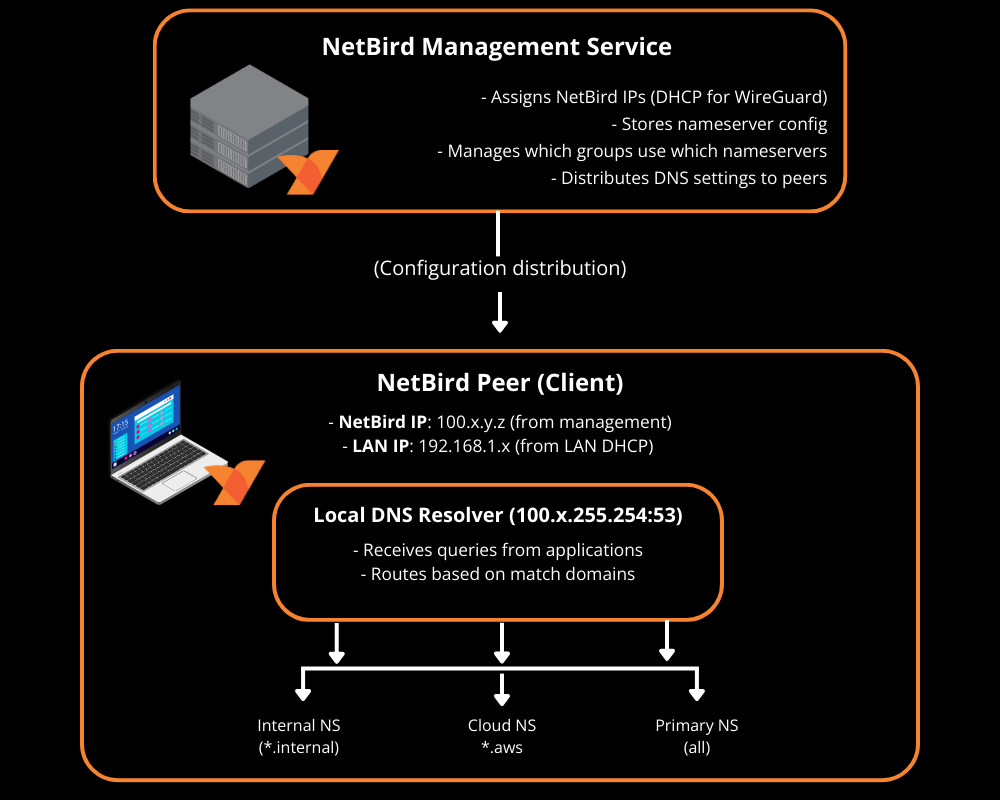
NetBird's DHCP Role
The NetBird management service acts as a DHCP server only for the NetBird network, not your LAN:
- NetBird IPs: Management assigns each peer a unique IP from one of 64 possible /16 blocks within the
100.64.0.0/10CGNAT range (e.g.,100.64.0.0/16through100.127.0.0/16). The block is randomly selected per account and can be customized. - LAN IPs remain unchanged: Your local network DHCP continues to work normally
- Two networks, two IPs: Each peer has both a LAN IP (e.g.,
192.168.1.100) and a NetBird IP (e.g.,100.121.5.10)
NetBird creates a parallel overlay network on top of your existing network infrastructure.
Query Routing
When an application makes a DNS query, NetBird's local resolver:
- Checks match domains: Does this query match a specific nameserver?
- If yes → Forward to that nameserver
- If no → Forward to primary nameserver
- Performs the query: Sends the request to the appropriate upstream nameserver
- Returns the result: Sends the IP address back to the application
Example with a primary nameserver (Cloudflare 1.1.1.1) and a match domain nameserver (company.internal → Internal DNS 10.0.0.1):
Query: "google.com"
→ No match → Primary (1.1.1.1) → Returns public IP

Query: "web.company.internal"
→ Matches company.internal → Internal DNS (10.0.0.1) → Returns private IP

Query: "server" (with search domain "company.internal")
→ Expanded to "server.company.internal"
→ Matches company.internal → Internal DNS → Returns private IP
NetBird does not cache most DNS queries. Caching only occurs for DNS forwarder on routing peers during upstream failures, and for NetBird infrastructure addresses (management, relay, STUN).
Each peer can have one primary nameserver and multiple match domain nameservers. If a peer belongs to multiple distribution groups, all nameserver configurations from those groups are merged. When multiple nameservers match a query, the most specific match domain wins.
Default Behavior (No Nameservers Configured)
If you don't configure any nameservers in NetBird, the behavior varies by platform:
Linux (always sets up DNS):
- NetBird always configures DNS so peer domain names (like
my-server.netbird.cloud) work - Your original nameservers are preserved as upstream
- Both NetBird peer domains and regular DNS continue to work
macOS/Windows/Mobile (only when nameservers configured):
- Without nameservers configured, NetBird doesn't modify DNS
- Peer domain names like
my-server.netbird.cloudwon't resolve - You can still use NetBird IPs directly (e.g.,
100.121.5.10)
You don't need to configure custom nameservers to use NetBird. On Linux, peer domains work automatically. On other platforms, you can use NetBird IPs directly or configure nameservers for domain resolution.
When you add custom nameservers:
- The local DNS resolver routes queries based on your match domain rules
- Custom nameservers can handle specific domains (split-horizon DNS)
- Primary nameservers handle all non-matched queries
DNS Setup Per Platform
NetBird configures the operating system to use its DNS resolver:
- Linux: Always sets up DNS via
/etc/resolv.conforresolvconf. Original nameservers preserved as upstream. - macOS: Uses system APIs. Match-domain nameservers become scoped resolvers (visible in
scutil --dns, not in/etc/resolv.conf); a primary nameserver makes macOS regenerate/etc/resolv.confwith NetBird's resolver in it - Windows: Sets the network adapter's DNS server to the local NetBird resolver
- Android/iOS: Uses VPN DNS configuration
Android: Custom DNS resolution requires disabling Private DNS. Go to Settings → Network & Internet → Private DNS and set it to Off. When enabled, Android bypasses VPN DNS.
The local resolver runs on 100.x.255.254:53 (in userspace mode), where x corresponds to the second octet of your NetBird /16 block.
DNS Forwarder on Routing Peers
When a Network resource uses a domain name, the routing peer runs a DNS forwarder that resolves domains on behalf of clients. The client's local resolver sends queries to this forwarder, which uses the routing peer's local DNS to resolve the domain and return the result.
The DNS forwarder listens on port 22054 (changed from 5353 in v0.59.0 to avoid collisions with mDNS). For backward compatibility, port 5353 is used if any peer in your account runs below v0.59.0.
NetBird attempts to automatically open the forwarder port on routing peer firewalls, but this may fail on some systems. If domain resources aren't resolving, verify the port is open: nslookup -port=22054 <domain> <routing-peer-ip>.
DNS Management Modes
NetBird supports two modes per peer group:
- Managed Mode (default): NetBird fully controls DNS settings. All queries go through NetBird's resolver.
- Unmanaged Mode: NetBird doesn't modify DNS settings. The peer uses its existing DNS configuration.
You can disable DNS management for specific groups in DNS Settings.
Match Domain Platform Support: Only macOS, Windows 10+, and Linux with systemd-resolved support nameservers with match domains. We recommend configuring at least one primary nameserver (without match domains) assigned to all peers.
What's Next?
- Internal DNS Servers - Configure nameservers and work with AD, BIND, and other internal DNS
- DNS Settings - Control DNS management per group
- Custom Zones - Create private DNS records distributed to peers
- Extra DNS Labels - Assign additional DNS names to peers for service discovery and load balancing
- Troubleshooting - Diagnose DNS issues
- API Reference - Automate DNS configuration