

Permissions
Updated
The Permissions tab in your account settings controls how much of the dashboard non-administrative users can see. It currently holds a single setting, Restrict dashboard for regular users.
To find it, log in to your NetBird dashboard and navigate to Settings > Permissions.
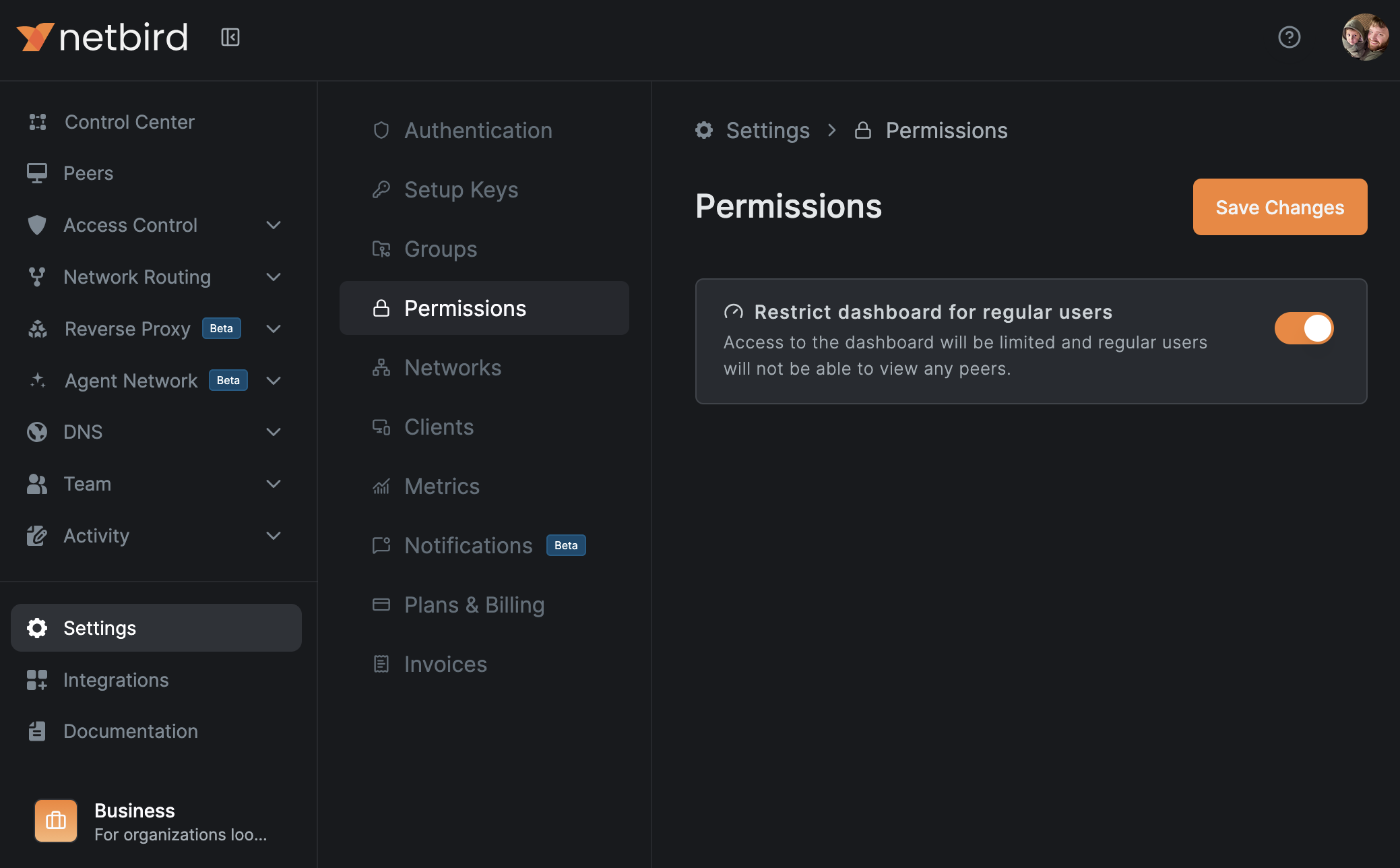
Restrict dashboard for regular users
When this setting is enabled, affected users get a reduced dashboard and cannot view any peers, including the peers they own themselves.
This setting is enabled by default on new accounts. If you want regular users to be able to see their own peers, you need to turn it off explicitly.
Who it applies to
The restriction applies to users with the following roles:
User(regular users)Billing Admin
Users with the Owner, Admin, Network Admin, or Auditor role are never affected, and neither are service users acting through an access token.
Despite the name, the setting also applies to billing admins. Since a Billing Admin's dashboard access is limited to billing pages regardless, in practice the setting mainly affects users with the User role.
What changes when it is enabled
Affected users keep their network access. The restriction is about visibility in the dashboard, not connectivity. Their peers stay connected and policies continue to apply as normal.
In the dashboard, those users see the following:
- The
Peerspage shows a blocked view instead of the peers table - Peer and group detail pages are not reachable and redirect back
- Group and country data is not loaded
- Parts of the navigation and account menu are hidden
Through the API, peer listing endpoints return an empty list for those users rather than an error.
What changes when it is disabled
Turning the setting off does not give regular users visibility of the whole network. They see only the peers they own, which is the standard behavior for the User role. Administrators continue to see all peers in the account either way.
Changing the setting
- Go to
Settings>Permissions. - Toggle
Restrict dashboard for regular userson or off. - Click
Save Changes.
You need permission to update account settings to change this, which in practice means an owner or administrator. Roles with read-only settings access, such as Network Admin and Auditor, can open the tab but the toggle is disabled for them.