

Token & Budget Limits
Updated
Limits cap how much a policy's callers can consume. They come in two halves, each enforceable per user and per group over a fixed time window.
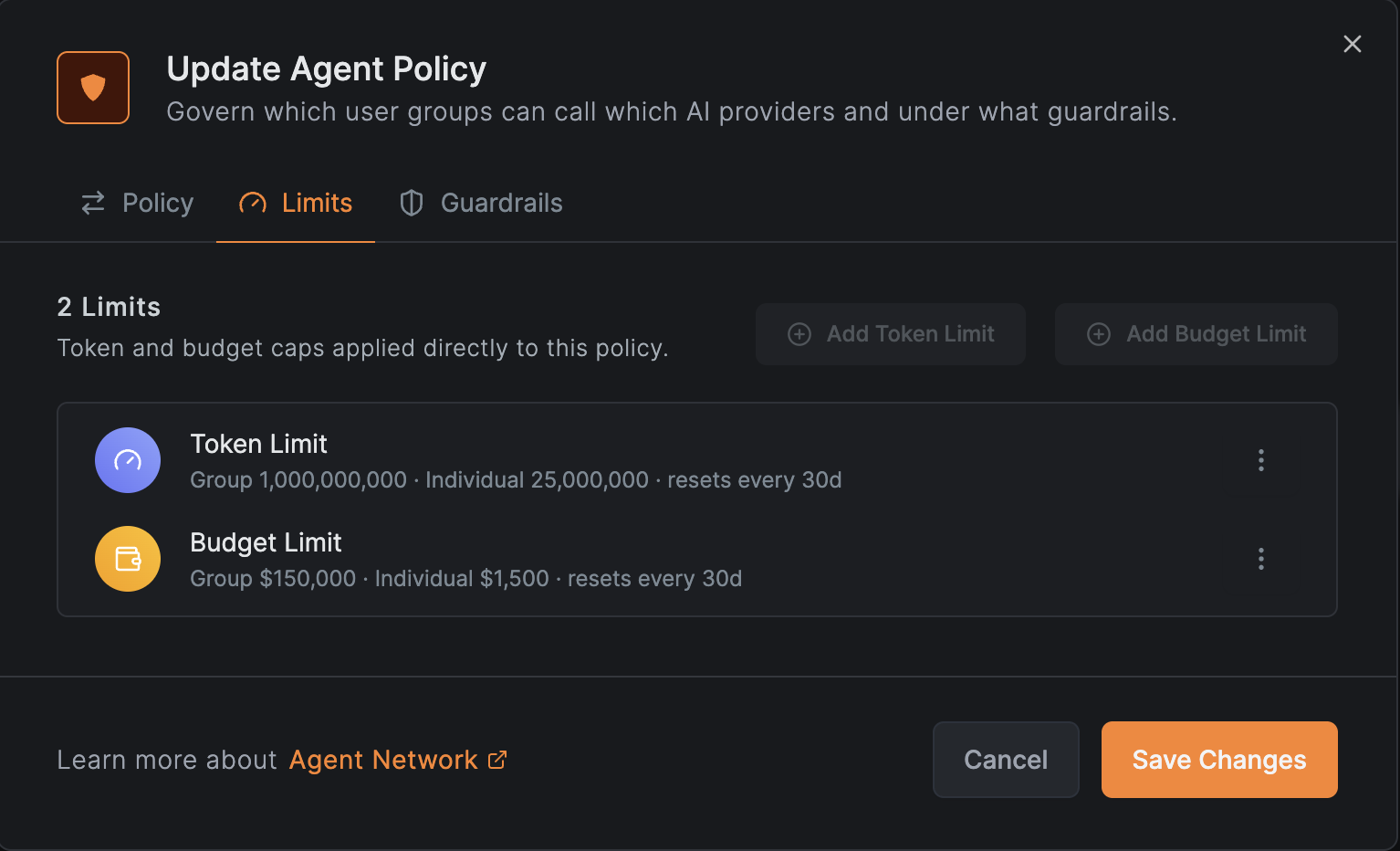
To enable limits, open the policy's Limits tab when creating or editing a policy, turn on the token and/or budget limit, and set the per-user and per-group caps and window.
Token Limits
- User cap: maximum tokens per user in the window.
- Group cap: maximum tokens per group in the window.
- Window: the fixed period the cap applies to (see below).
Budget Limits
- User cap (USD): maximum spend per user in the window.
- Group cap (USD): maximum spend per group in the window.
- Window: the fixed period the cap applies to (see below).
How the Window Works
A cap applies to a fixed window, not a sliding one. NetBird divides time into
back-to-back buckets of the window's length, aligned to a fixed grid starting from the
Unix epoch (1970-01-01T00:00:00Z). Each request is counted into the bucket its timestamp
falls in, and the cap is compared against the total accumulated in the current bucket.
When the window rolls over to the next bucket, the counter effectively starts again at
zero.
The bucket boundary is computed as:
window_start = floor(now / window) * window
This alignment is deliberate: because every node derives the same boundaries from the same clock, usage adds up consistently across a clustered deployment instead of drifting with each node's first request.
Example: a 1-hour (3600s) window. Buckets run from the top of each hour in UTC:
13:00:00–13:59:59, 14:00:00–14:59:59, and so on. A request at 13:45 counts toward the
13:00 bucket; a request at 14:02 lands in a fresh 14:00 bucket with the counter back
at zero, regardless of when the user's first request of the day was.
How Enforcement Works
Caps are checked before the request runs, against usage already accumulated in the
current window. The check is used >= cap: if the running total has not yet reached the
cap, the request is allowed; once it has, the request is denied with a reason surfaced in
the access logs.
Because the check uses the total before the request (NetBird doesn't reserve or pre-estimate the request's own cost), a single request can push usage past the cap. The request that crosses the line still completes; the next one is blocked.
Example. A token cap is set to 1000 for a group, and the group has used 999 in the
current window:
- The next request is checked:
999 >= 1000is false, so it goes through: even though it then consumes, say, 250 tokens and pushes the total to1249. - The following request is checked:
1249 >= 1000is true, so it is blocked until the window rolls over.
So a cap is a floor for when blocking starts, not a hard ceiling on the exact total. Plan caps with a little headroom if you need a strict upper bound.
For account-wide caps that apply across all policies. See Global Limits.